May 17, 2011

Cervical Cancer

Types | Causes | Symptoms | Diagnosis | Stages | Treatment
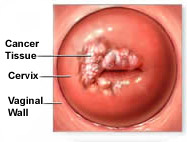
Cervical cancer or cancer of the cervix is an abnormal growth of malignant (cancer) cells  in the cervix. It is the second most common cancer in females and it is successfully curable in the early stages. Cervical cancer occurs most commonly between 40 and 55  years of age. 
The cervix is the opening of the uterus connected to the upper vagina. It is known as the neck of the uterus. The lower end of the cervix has an opening called the external os, and before childbirth it is about 5mm in diameter. It dilates to 10cm during labour  to allow for childbirth and never regains its former shape, changing to a slit approximately 7mm long.  Normally the cervix is pink in colour but turns bluish in pregnancy because of an increased blood supply.

The surface layer of the cervix is made up of two different types of cells, flat cells called squamous cells and tall column-like gland cells called columnar cells. This produces a mucous membrane, but the mucous membrane of the cervix is smooth. The place where squamous and columnar cells meet is known as the transformation zone and this is the area of the cervix where cancer most commonly arises.  The cancer cells may be present in the cervix for 4-10 years before becoming invasive, affecting the deeper tissues and giving rise to symptoms. Even when the cancer is invasive , there is an 80% chance of successful cure. Once it spreads through the pelvis to the vagina, uterus, bladder or rectum, it is much more difficult to cure. 
Note : All statements given are only for information purpose. We are not responsible or liable for any problems related to the utilization of information on this site. We suggest that you consult a qualified doctor before trying any alternative health care remedies.

Breast Cancer

Causes | Symptoms | Diagnosis | Stages | Treatment
Sometimes abnormal cells develop in the breast tissue, forming a lump or tumor. This is the most common type of cancer in women. 
The breast has several lobes, which are divided into lobules and end in the milk glands. Tiny ducts run from the many tiny glands, connect together, and end in the nipple. Any tissue in the breast can be affected and it will destroy the nearby tissues also.  Usually the cancer arises from tissue that forms milk ducts. There are at least 15 different  kinds, depending on the site  of development . Both women and men can develop breast cancer, but it is very rare in men.
Breast cancer occurs more commonly in the left breast than the right and more commonly in the outer upper quadrant. The tumor may distort the shape of the breast or the texture of the skin as it becomes larger. It can be detected when it grow large enough to either be felt or seen on a mammogram.  
The cancer cells spread through the specialised channels in the breast called lymphatics to the lymph nodes to form tumors. It also spread or metasize to the other parts of the body through the blood stream. It spreads through the right side of the heart to the lungs, and eventually to the other breasts, the chest wall, liver, bone and brain. Spreading of the tumor to other parts of the body can cause death.
Breast cancer can be classified by histologic appearance and location of the lesion. 
  • Adenocarcinoma - arising from the epithelium.
  • Intraductal - developing within the ducts
  • Infiltrating - Occurring in parenchyma of the breast.
  • Inflammatory - reflecting rapid tumor growth, in which the overlying skin become edematous, inflamed and in-durated.
  • Lobular carcinoma in situ - reflecting tumor growth involving lobes of glandular tissue.
  • Medullary or circumscribed - large tumor with rapid growth rate.

Menorrhagia

It is menstruation  with abnormally heavy or prolonged  blood flow. This may be frequent periods, one that continuous for 7 days or more, or one with exceptionally heavy flow over two to three days. Menorrhagia can occur because of fibroids, inflammation in the pelvic cavity, an Intrauterine device  (IUD) or hormonal imbalance.
The bleeding can cause anaemia with pallor fatigue, which can be treated with iron supplements. Treatment depends on the cause and may include a D and C, the combined contraceptive  pill, removal of an IUD, or danazol, a drug that inhibits the hormones produced by the pituitary gland.

Mastitis inflammation of the breas

It occurs usually because of bacterial infection during breast feeding. Symptoms include, pain in the affected breast, tenderness, swelling, fever and possibly a chill. Treatment with warm compress and antibiotics normally resolves the condition. If the inflammation does not subside then a breast abscess may form.

Gonorrhoea

It is an extremely common venereal or sexually transmitted disease, that is caused by the bacterium Neissera-gonorrhoeae. The bacteria are found in the Mucous Membrances of the Vagina, Urethra, throat and mouth.  If gonorrhoea is not treated it can damage and inflame the Fallopian Tubes and other pelvic organs, and this can arise after only 8-10 weeks. Other possible damage includes eye infection that can cause blindness, septicaemia (blood poisoning), Gonococcal Arthritis, it may occur in conjunction with a painful skin rash and inflammation of heart valves. Symptoms of  gonorrheoa include vaginal discharge (green or yellow in colour), Dysuria,  possible inflammation  of the rectum  and a sore throat . To diagnose the disease, swabs of the discharge are obtained and organisms  grown are identified in the laboratory. Treatment  is by a single , very large dose of penicillin, or tetracycline if the organisms is resistant to penicillin.

Pelvic Inflammatory Disease (PID)

It is an inflammation of the Fallopian Tubes, ovaries and Uterus. The disease can be acute or chronic.  Acute PID causes severe abdominal pains, high fever , chills, foul-smelling vaginal discharge and abdominal tenderness. PID is a result of bacterial infection, but chlamydia and Gonorrhoea are responsible for mini cases. Treatment is by means of antibiotics and bed rest. The condition usually improve within two weeks. But if not, another antibiotics is given. If 3 courses of antibiotics do not clear the infection, then the disease is deemed to have become chronic, Chronic PID results in a low level of infection that can continue for weeks or months.
Symptoms are persistent  abdominal pain or cramps, fatigue, weakness and very heavy menstrual periods. Some mild cases have few  or no symptoms but can cause partial or total infertility.

Osteoporosis

A condition in which the amount of bone mass decreases to the point where the bones are fragile and easily fractured, affecting twice as many women as men. Women are particularly risk from the osteoporosis as they have a lower density of bone, because of smaller body size than men. The risk increases those who have a premature menopause, early hysterectomy, previous anorexia nervosa etc. Also women who smoke or drink excessively are at the greater risk. Weight-bearing exercise , a diet rich in calcium, Vitamin D and other minerals, and not smoking can help to prevent bone loss. Hormone replacement therapy is the most effective preventive treatment but is not suitable for all women. Physiotherapy and acupunture can help to relieve pain. Osteoporosis can be detected by doing Bone Density Test

Leucorrhoea

A discharge of white-yellow coloured mucus from the vagina. it may be normal condition, increasing before and after menstruation, but a copious vaginal discharge, especially if it has a strong smell, probably indicates an infection  in the genital tract. A common cause is thrush, but it may also be because of Gonorrhoea or some other sexually transmitted disease.

Amenorrhoea (Absence of periods)

It is a failure to have periods, which may be described as primary or secondary . Primary amenorrhoea is the failure to menstruate  by age 16, and the main  cause is the late onset of puberty. A girl may have the other signs of puberty  but lack of periods. this may be a cause of a pituitary tumor, which can be found  via a skull X -ray , or because of cryptomenorrohea, where menstrual bleedings does occur but it is held inside the vagina  by an obstruction such as imperforate  Hymen. The condition  may arise because parts of the female reproductive system are missing. The most common reason for primary amenorrhoea is disruption  of the relationship  between  the ovaries  and the pituitary gland.
Secondary amenorrhoea occurs  when a woman stops  menstruating  for 3 months  or more  after normal menstrual  periods have been established but before the onset of the Menopause.  It may arise  as a result of stress, chronic  diseases.  Stopping the contraceptive pill, which affects  hormone  production  in the brain , can cause amenorrhoea for up to a year, and it may arise after child birth and breast feeding. Failure of ovaries, prompting a premature  menopause before the age of 40, is another cause.  Amenorrhoea is permanent after the menopause or if the uterus is removed in a Hysterectomy

Common diseases

Acne | Amenorrhoea | Leucorrhoea | Osteoporosis | Pelvic Inflammatory Disease (PID) | Gonorrhoea | Mastitis | Menorrhagia | Breast Cancer | Cervical Cancer

Note : All statements given are only for information purpose. We are not responsible or liable for any problems related to the utilization of information on this site. We suggest that you consult a qualified doctor before trying any alternative health care remedies.

Acne


Acne


It is a  common inflammatory skin disease that mainly  affects the face, neck, chest and upper back. it is caused by an interaction between hormones, bacteria and sebum produced by the comedones (pimples), pustiles (lesions  filled with pus) and occasionally CYSTS. This is possibly caused  by changing hormone levels.
Mild cases may be eased by washing  the face with a gentle toilet soap or by drying agents  such as benzoyl peroxide. Severe acne may need oral treatment  with antibiotics such as tetracycline or hormone therapy  such as Dianette, which also acts as a Contraceptive.
Very severe acne can be treated using a derivative of Vitamin A, called tretinoin or Retin A. This cream is applied in each night  and takes about  3 weeks  to be effective. An oral version called  Ro- accutane is very good against severe acne but carries serious risks  of foetal  abnormality during pregnancy.


Trace Minerals Glossary

By , About.com Guide
Updated May 14, 2011
About.com Health's Disease and Condition content is reviewed by our Medical Review Board
These minerals are all essential for good health, but your body only needs a very small amount of each one. These trace minerals are important for immune system function, energy, metabolism and antioxidant protection.

Chromium

BroccoliEyewave/iStockphoto
Chromium is necessary for normal metabolism and storage of sugar and starch. Chromium is found in a wide variety of foods, so deficiencies are very rare. Learn more about chromium.
Sponsored Links

Major Minerals Glossary

By , About.com Guide
Updated July 22, 2009
About.com Health's Disease and Condition content is reviewed by our Medical Review Board
The major minerals are the six dietary minerals your body needs in the largest amounts. These minerals are necessary for many processes in your body, especially fluid balance, maintenance of bones and teeth, muscle contractions and nervous system function.

Calcium

Dairy ProductsTy Smith
Probably best known for preventing osteoporosis, calcium is necessary for much more than strong bones and teeth. Calcium is found in dairy products and dark green vegetables. Learn more about calcium.

Chloride

CeleryMike Fitzpatrick
Chloride is a major mineral that your body needs to make digestive juices and to keep body fluids balanced. Chloride is found in salt and many vegetables, including celery and tomatoes. Learn more about chloride.

Magnesium

Mixed nutsMike Coombes
Magnesium is important for many biochemical functions. It's found in nuts, seeds, whole grains, legumes and dark green vegetables. Learn more about magnesium.

Phosphorus

SteakGreg Nicholas
Phosphorus is important for bone growth, energy production and normal cell membranes. Foods that are high in protein such as meats, nuts, seeds and legumes are also high in phosphorus. Learn more about phosphorous.

Potassium

SaladNiels Rameckers
Potassium is important for nervous system function, muscle contraction and fluid balance in the body. Potassium is found in fruits and vegetables. Learn more about potassium.

Sodium

SaltAnka Draganski
Your body needs sodium to maintain fluid balance and blood pressure. Sodium is found in many foods, but the best known source is salt. Learn more about sodium.

Fat-Soluble Vitamins


By , About.com Guide
Updated May 14, 2011
About.com Health's Disease and Condition content is reviewed by our Medical Review Board
The fat-soluble vitamins are vital for many of the functions your body needs to stay healthy, including cell differentiation, immune system function and they'll help to keep your bones strong. Your body stores the fat-soluble vitamins in your body, so you need to be careful with dietary supplements that include fat-soluble vitamins.

Vitamin A

CarrotsPat Herman
Vitamin A is important for normal vision, adequate growth, immune system function and for cell division and differentiation. It's found in butter, egg yolks, fish, liver, meats, whole milk, dark green vegetables, yellow, and orange fruits and vegetables. Learn more about vitamin A.

Vitamin D

sunlightChris Chidsey
Vitamin D is required to absorb and utilize calcium, which keeps your bones and teeth strong. It's not found in many foods unless they have been fortified. Normally, your body makes vitamin D when your skin is exposed to sunlight. Learn more about vitamin D.

Vitamin E

SunlightJillian Pond
Vitamin E is important as an antioxidant that protects the cells of your body from free radical damage. It's found in nuts, seeds, vegetables oils, cereals and dark green leafy vegetables. Learn more about vitamin E.

Vitamin K

SpinachFlorin Bleiceanu
Vitamin K is important for normal blood clotting and may help to keep your bones strong as you age. It's found in dark green leafy vegetables, cabbage, cauliflower, broccoli, and soybeans. Learn more about vitamin K.

Water-Soluble Vitamins

By , About.com Guide
Updated May 14, 2011
About.com Health's Disease and Condition content is reviewed by our Medical Review Board
The water-soluble vitamins are vital for many of the functions your body needs to stay healthy, including energy production, immune system function and they'll help to keep your heart healthy. Your body doesn't store most of the water-soluble vitamins very long, so they need to be replenished daily.

Vitamin C

Orange JuiceSteve Woods
Vitamin C is found in most fruits and vegetables, especially citrus fruits, strawberries, peppers and potatoes. You need vitamin C for a healthy immune system and for healthy skin. Learn more about vitamin C.

hiamine

breadAndre Lubbe
Thiamine is found in legumes, fish, lean meats, whole grains and fortified breads and cereals. You need thiamine to help your body make energy out of the carbohydrates you eat. Learn more about thiamine.

Riboflavin

MilkDawn Allyn
Riboflavin is found in lean meats, eggs, leafy green vegetables, nuts, legumes, fortified breads and cereals,milk and dairy products. You need riboflavin for general body growth and for energy. Learn more about riboflavin.

Niacin

nutsMike Coombes
Niacin is found in dairy products, poultry, fish, lean meats, nuts, legumes and eggs. You need niacin for healthy skin and for converting the foods you eat to energy. Learn more about niacin.

Pantothenic Acid

Cut Fruits and VegetablesPeggy Greb
Pantothenic acid is found in a wide variety of foods including organ meats, eggs, fish and shellfish, poultry, legumes, whole grains, dairy products, cruciferous vegetables, avocados, and mushrooms. You need pantothenic acid for energy production. Learn more about pantothenic acid.

Vitamin B6

SalmonTondo Susanto
Vitamin B6 is found in a variety of foods such as fish, meat, beans and legumes and many vegetables. You need vitamin B6 for a healthy nervous system and for making hemoglobin. Learn more about vitamin B6.

Folate

SpinachFlorin Bleiceanu
Folate is found in leafy green vegetables such as spinach, fruits like oranges and strawberries, legumes and whole grains. Your body needs folate to make red blood cells and for breaking down the proteins you eat. Learn more about folate.

Vitamin B12

steakGreg Nicholas
Vitamin B12 is found in meats, poultry, seafood, eggs, and dairy products. You need vitamin B12 for a healthy nervous system and blood cell production. Learn more about vitamin B12.

Know Your Vitamins and Minerals

By , About.com Guide
Created November 04, 2010
About.com Health's Disease and Condition content is reviewed by our Medical Review Board
Vitamins and minerals are called micro-nutrients because you only need a small amount of them, compared to the macro-nutrients you need in large amounts: carbohydrates, proteins and fats. Although you only need small amounts of vitamins and minerals, they're crucial for good health.
A healthy, balanced diet should provide you with the vitamins and minerals your body needs. However, people who have certain health conditions, eat nutrient-poor diets, or are taking some types of medications may need to take some dietary supplements to ensure they get enough of all these vitamins and minerals.

1. Water-Soluble Vitamins

Fresh FruitsAngelika Stern
The water-soluble vitamins include thiamine, riboflavin, niacin, pantothenic acid, B6, folate, B12 (the B-Complex family of vitamins) and vitamin C. They are vital for many of your body's functions, including energy production and immune system function, and they'll help to keep your heart healthy.
Your body doesn't store most of the water-soluble vitamins very long, so they need to be replenished daily. Learn more about the water-soluble vitamins.

2. Fat-Soluble Vitamins

Pretty vegetablesMichel Marcon
The fat-soluble vitamins include vitamins A, D, E and K, and are vital for many of the functions your body needs to stay healthy, including cell differentiation and immune system function, and they'll help to keep your bones strong.
Your body does store the fat-soluble vitamins; however, you still need small amounts each day to keep up those stores. Learn more about fat-soluble vitamins.

3. Major Minerals

milk and dairy productsTy Smith
The major minerals are calcium, chloride, magnesium, phosphorus, potassium and sodium. These minerals are necessary for many processes in your body, especially fluid balance, maintenance of bones and teeth, muscle contractions and nervous system function. Learn more about the major minerals.

4. Trace Minerals

Mixed nutsMike Coombes
These minerals include chromium, copper, fluoride, iodine, iron, manganese, molybdenum, selenium and zinc. They are all essential for good health, but your body only needs a very small amount of each one. These trace minerals are important for immune system function, energy, metabolism, and antioxidant protection. Learn more about the trace minerals.
Related Articles

Which Form of Vitamin D is Better, D2 or D3? By Shereen Jegtvig, About.com Guide


vitamin d capsuls
What's best, D2 or D3?
Tanja Sund
Sponsored Links
25-OH Vitamin D Test KitFDA cleared excellent performance Measure Total D (D2 and D3)www.diazyme.com/
98% Thyroid Disease Cured100% Natural Herbs, with TGA, GMP, SGS. Thousands of recovery cases!www.greenlife-herbal.com
Tongkat Ali - Tung SawTongkat Ali powdered and extracts wholesale priced to public. Strong.AinterolHerbs.Com
Sponsored Links
Stop Aging NowSex Hormones Testing Stay Young and Stay Sexy!www.hallongevity.com
Natural Herb SolutionIdeal Herb Combination for Diabetes Obesity and Metabolic Syndrome.www.EastwoodCompanies.com
Question: Which Form of Vitamin D is Better, D2 or D3?
I want to take vitamin D supplements, but some people tell me I should only take D3 vitamin D supplements and not D2. What's the difference? Rusty - About.com User
Answer: That's a great question, but I'm not convinced that it really makes much difference, at least for most of us who just want to increase our intake of vitamin D. If I were to pick out a vitamin D supplement, I would lean toward one with D3, but it may not matter that much - after all, D2 has been used for many years.

What's D2 and D3 Anyway?

Vitamin D is a substance your body synthesizes after your skin is exposed to sunlight, however it is also available in fish oil and in foods that have been fortified with vitamin D. In your body, vitamin D acts like a hormone to help your body absorb and use calcium and regulate the amount of calcium in your blood. If you don't get enough vitamin D, you'll increase your risk of osteoporosis, or other bone-weakening diseases such as osteomalacia and osteopenia. Vitamin D is also important for a healthy immune system and normal nerve and muscle function. Now for a little bit of vitamin D biochemistry (very little, I promise). Cholecalciferol (that's D3) is the form of vitamin D found in animals. When your skin is exposed to the UVB rays of sunlight , your body converts something called 7-Dehydrocholesterol (related to cholesterol) through a series of biochemical steps to cholecalciferol. Then through another step, the cholecalciferol is converted to calcifediol, which is also called 25-hydroxyvitamin D3 and is the form that the laboratory measures when your doctor orders a vitamin D test. Finally your body turns calcifediol into the active form of vitamin D (the one that does the work) called calcitriol.
Plants go through a similar process, but instead of cholecalciferol, plants have ergocalciferol (D2). Cholecalciferol and ergocalciferol are very similar chemically and in late 1920s it was discovered that ergocalciferol was effective for treating rickets in children. For decades, ergocalciferol has been accepted as a supplementary form of vitamin D.
In the 1980 and 90s, scientists suggested that the animal form, D3, was more effective for raising blood levels of vitamin D3 (25-hydroxyvitamin D3). Since then two more studies found no difference between the two forms and a third detected more effective increases with D3, but the researchers weren't clear if it really made much therapeutic difference.
Why such different results? Lots of factors can affect research studies of this type. One study was done in the summer so sun exposure could have messed up the results. And maybe diet and use of dietary supplements can change things. Plus who is the best group of people to study? People with osteoporosis? Kidney disease? Healthy people who may just be a little low in vitamin D? Old people? Young people? Men? Women? Research can be difficult because the findings for one group of people be the same for another.
I'm sure more research will be done on the differences between D2 and D3, but in the meantime if you're concerned about your vitamin D levels, the best thing to do is go to a health care provider to have your blood levels of vitamin D checked. If they're low, you can take either form of vitamin D and after a few weeks, have your blood checked again to see if the supplements are working. Always follow the label directions for taking vitamin D supplements unless your health care provider tells you differently.
Sources:
A Comparison of Ergocalciferol and Cholecalciferol Therapy in Hemodialysis Patients and Effect on Parathyroid Hormone. Poster Session: Mineral Metabolism: Bone Disease (10:00 AM-12:00 PM) Poster Board Number: SA-PO2820. Accessed February 4, 2010. http://www.abstracts2view.com/asn/view.php?nu=ASN09L1_235a.
Armas LA, Hollis BW, Heaney RP. "Vitamin D2 is much less effective than vitamin D3 in humans." J Clin Endocrinol Metab. 2004 Nov;89(11):5387-91.
Glendenning P, Chew GT, Seymour HM, Gillett MJ, Goldswain PR, Inderjeeth CA, Vasikaran SD, Taranto M, Musk AA, Fraser WD. "Serum 25-hydroxyvitamin D levels in vitamin D-insufficient hip fracture patients after supplementation with ergocalciferol and cholecalciferol." Bone. 2009 Nov;45(5):870-5.
Holick MF, Biancuzzo RM, Chen TC, Klein EK, Young A, Bibuld D, Reitz R, Salameh W, Ameri A, Tannenbaum AD. "Vitamin D2 is as effective as vitamin D3 in maintaining circulating concentrations of 25-hydroxyvitamin D." J Clin Endocrinol Metab. 2008 Mar;93(3):677-81.
Houghton LA, Vieth R. "The case against ergocalciferol (vitamin D2) as a vitamin supplement." Am J Clin Nutr. 2006 Oct;84(4):694-7.
NIH Office of Dietary Supplements. "Dietary Supplement Fact Sheet: Vitamin D." Accessed February 4, 2010. http://ods.od.nih.gov/factsheets/vitamind/.

May 16, 2011

Get Your Free Health Coach Starter Guide

Get Your Free Health Coach Starter Guide Fill out the form below to receive… * Free book chapter on how to find work you love * The inspiration YOU need to create a fulfilling career in health and nutrition * Free video on the Future of Nutrition from Joshua Rosenthal We have a NO SPAM policy. First Name: Email: Phone: Please have an Admissions Advisor call me.

May 14, 2011

Seafood Safety

Get live crab!

Our first installment of informational posts:

Real and Imaginary Concerns
News reports talk more about the dangers, then the benefits of eating seafood. Should you be afraid to eat fish? In a word, NO! Your health has much more to gain from eating fish, especially fatty species, such as: Salmon, Herring, Mackeral, Sardines and Rainbow Trout, then by avoiding seafood. In fact, people who eat seafood regularly are healthier than those who do not. But there are some potential dangers and it is good to know about them.
Real healthy concerns come from eating fish and shellfish that carry bacteria, viruses or toxins that cause illness. Like other foods, spoiled fish can make you ill, so it is important to refrigerate seafood right after you buy it, at a temperature as close to 32 F degrees as possible. Eat fish as soon as you can, after you buy it. Keep frozen seafood as cold as possible, and avoid storing it for too long. This is because freezers change temperatures often and fish quality declines.
Imaginary dangers are those that could occur under unusual circumstances, but are not generally a problem in the U.S. An example of this potential health risk from PCBs and dioxins. These contaminants are found only in extremely small amounts and are publicized in the news.

Will Seafood make you ill?
Most fish in the marketplace is completely safe to eat. However, certain species and some fish from tropical waters can be riskier than others. Not all fish or shellfish have substances that cause illness and not everyone who eats fish with disease causing agents will become ill. That is because disease organisms vary in their ability to cause illness. People, too, differ in their susceptibility to harmful substances. People who are most likely to become ill include: elderly people, pregnant women and young children, and those with impaired immune systems (e.g., those with HIV\AIDS, liver disease, diabetes, cancer, gastrointestinal disorders, and people taking steroids, chemotherapy, or immune suppressant drugs).
The greatest danger comes from eating raw or partially cooked mollusks (snails, oysters, mussels, clams, octopus and squid). Not all mollusks are contaminated, but there is no way to tell if they are. Because the diseases linked to raw shellfish are serious, the safest practice is to avoid eating raw shellfish. However, states producing shellfish must abide by strict limits on bacteria count, so illness from eating raw shellfish has become less common.
Harmful viruses are almost always linked to shellfish harvested from waters contaminated with sewage. The two most common are Norwalk virus and hepatitis A. Norwalk virus causes gastrointestinal upset, but symptoms usually subside after 48 hours. Hepatitis may not be detected for 2-6 weeks and can be long-lasting and severe. Hepatitis A virus can survive light cooking, so simply steaming shellfish until the shells open may not destroy all the virus, if it is present.
Bacteria mostly occur in shellfish but can be present in some ready to eat fish products. Cooking destroys most bacteria, so again, the danger lies mainly with raw shellfish. The family bacteria known as “Vibrios” can cause serious illness, especially in people with compromised immune systems. Illness from ready to eat seafood occurs only rarely.
Besides viruses and bacteria, some fish-mainly species from tropical or subtropical waters- may have toxins that cause illness. The two most common types are ciguatoxin and scombrotoxin, or histamine poisoning. Ciguatoxin is found mainly in reef fish such as barracuda, grouper, and snapper. There is no way to tell whether a particular fish contains the toxin and not all fish caught in the same area will have the toxin.
The other toxin, histamine, is associated mainly with mahi mahi, fresh tuna, mackerel and bluefish. The toxin develops when fish have not been kept sufficiently cold after harvesting and shipping. Symptoms of illness develop quickly after eating the affected fish, but usually disappear within 24 hours.

The Safest Seafood
Canned fish and shellfish are the safest forms of seafood because they are cooked and have been tightly sealed. They are suitable for people of all ages and health conditions.
Seafood Storage: Store all fish and shellfish in the refrigerator or freezer. Live shellfish should have ventilated containers. Do not store live shellfish in water. Use as quickly as possible and discard all dead animals (shells do not open after cooking) and any with broken shells. Live crabs, lobster and crayfish move their legs. Do not cook or eat any dead shellfish.
Raw seafood to be cooked: When preparing raw seafood at home, first wash your hands with soap and hot water. Then, be sure that no cutting board, wrap, utensils, or containers used for raw seafood come into contact with cooked item. Viruses and bacteria can easily transfer to the cooked food and provide an opportunity for the illness. Thoroughly scrub all materials that touched raw seafood.
Frozen Seafood: Thaw frozen seafood in the refrigerator or under cold running water. Do not thaw at room temperature or in warm water. Doing so will enable bacteria to grow. When possible, cook frozen fish and shellfish directly in the frozen state.
Raw, marinated, and smoked seafood: Use only commercially frozen shellfish and fish to prepare sushi, gravlox, ceviche, or at home smoked seafood. This will eliminate any possible parasites that may be in the fish. Use only shellfish obtained from reputable stores and has come from certified shellfish growing waters. Fish stores should have the certification tags on display. Raw, marinated, or partly cooked can be safe for healthy people, but may not be so for people with compromised immune systems. Pregnant women are taking unnecessary health risks eating these seafoods during pregnancy.
Environmental Contaminants
Mercury is a contaminant found in small amounts in all fish and shellfish. Too much mercury can be risky for pregnant women and young children. They should avoid eating species with high mercury levels—shark, swordfish, king mackerel and tilefish. Eating a variety of species reduces the chance of getting too much mercury. Fortunately, recent analysis showed that Alaskan salmon, cod andpollock have among the lowest levels of mercury of all seafoods. Mackerel, herring and sardines are also low in mercury. Everyone can eat these fish without worrying about safety. Organic contaminants such as PCBs, dioxins and pesticide residues are generally found only in very low amounts in most fish sold commercially. Current consumption of these contaminants from commercially available fish and shellfish has not been linked to any health risks. Experts agree: the health benefits from eating fish far outweigh any risks.

Written by Joyce A. Nettleton, DSc, RD, ScienceVoice Consulting, Denver, CO
Obtained from: Alaska Seafood.org


May 11, 2011


By Steven Reinberg
HealthDay Reporter

Anemia Drug May Worsen Heart Attacks

Study finds Procrit offers no cardiac protection, may increase risk after acute attack

TUESDAY, May 10 (HealthDay News) -- People given a drug known as erythropoietin alfa after a heart attack may experience new heart problems and even greater cardiac damage from the attack, a new study finds.
The drug, which stimulates red blood cells, has been used in some heart attack patients because certain studies suggested it might reduce the extent of heart attack damage and improve heart function, the researchers explained.
The study was published in the May 11 issue of the Journal of the American Medical Association.
"This study shows that erythropoietin should only be used with caution in patients with recent heart attacks," said Dr. Deepak L. Bhatt, chief of cardiology at the VA Boston Healthcare System, who was not involved in the study.
In fact, "there are hints in this study that the use of erythropoietin might have adverse cardiac effects," said Bhatt, who is also an associate professor of medicine at Harvard Medical School and the author of an accompanying editorial in the journal. This does not mean the drug doesn't have its place, for example, to help reduce transfusions in people with low blood counts, he added.
Known as erythropoiesis-stimulating agents (ESAs), erythropoietin drugs include Procrit and Epogen. They are typically used to treat anemia in cancer patients and to lower the risk of transfusions.
For the new study, dubbed the REVEAL trial, 222 heart attack patients in multiple centers across the United States were randomly assigned to receive erythropoietin alfa or a placebo after undergoing a balloon angioplasty or stent placement to open blocked heart vessels.
The patients had all suffered the most critical type of heart attack -- an ST segment elevation myocardial infarction, or STEMI. Because these patients are in danger of cardiac tissue death due to a local lack of oxygen (infarct) and other changes that increase the chance of heart failure and death, the researchers wanted to see whether erythropoietin alfa might have a protective effect.
The trial was led by Dr. Samer S. Najjar, of the Med-Star Health Research Institute at the Washington Hospital Center, in Washington, D.C. As a phase 2, randomized, double-blind trial involving a placebo and control group, in which neither the patients nor the researchers knew who was getting medication or the sham treatment, it is the type of study considered the gold standard of research.
The heart attack patients taking erythropoietin alfa received an intravenous dose of the medication four hours after a primary or rescue angioplasty or stent procedure; the control group received a saline infusion. Each patient underwent two cardiovascular magnetic resonance imaging scans, one before and one after treatment with erythropoietin alfa or the placebo.
The researchers found the size of the damaged area of the heart remained the same after each scan in both the erythropoietin alfa and placebo groups.
However, among patients 70 and older given erythropoietin alfa, heart damage actually increased over the first week after treatment, the researchers said.
Moreover, five patients receiving erythropoietin alfa either died, had another heart attack or had a blockage in the stent placed during angioplasty. None of the patients receiving placebo had these problems, the researchers said.
This is not the first time Procrit and other ESAs have been linked to serious adverse events. Last year, problems with ESAs prompted the U.S. Food and Drug Administration to require tighter guidelines on them for cancer patients because of the increased risk of stroke, heart failure, tumor promotion and death seen among those taking them.
Commenting on the study, Dr. Gregg Fonarow, the associate chief of cardiology at UCLA's David Geffen School of Medicine, said that "there has been substantial interest in the development of cardioprotective agents which could be administered during acute myocardial infarction (heart attack)."
There has been a growing body of experimental data that suggests erythropoietin may have anti-inflammatory properties and other qualities that could protect the heart, but earlier studies evaluating the effects of erythropoietin have been small, with conflicting results, he added.
"These findings, together with prior studies, suggest that there are not clinically relevant cardioprotective effects with erythropoietin-stimulating agents in patients with acute myocardial infarction," Fonarow said.
More information
For more information on ESAs, visit the U.S. Food and Drug Administration.
SOURCES: Deepak L. Bhatt, M.D., M.P.H., chief of cardiology, VA Boston Healthcare System Director, Integrated Interventional Cardiovascular Program, Brigham and Women's Hospital & VA Boston Healthcare System, associate professor of medicine, Harvard Medical School, Boston; Gregg Fonarow, M.D., associate chief, cardiology, David Geffen School of Medicine, University of California, Los Angeles; May 11, 2011, Journal of the American Medical Association