By Steven ReinbergHealthDay Reporter

Anemia Drug May Worsen Heart Attacks
Study finds Procrit offers no cardiac protection, may increase risk after acute attack
TUESDAY, May 10 (HealthDay News) -- People given a drug known as
erythropoietin alfa after a heart attack may experience new heart
problems and even greater cardiac damage from the attack, a new study
finds.
The drug, which stimulates red blood cells, has been used in some
heart attack patients because certain studies suggested it might reduce
the extent of heart attack damage and improve heart function, the
researchers explained.
The study was published in the May 11 issue of the
Journal of the American Medical Association.
"This study shows that erythropoietin should only be used with
caution in patients with recent heart attacks," said Dr. Deepak L.
Bhatt, chief of cardiology at the VA Boston Healthcare System, who was
not involved in the study.
In fact, "there are hints in this study that the use of
erythropoietin might have adverse cardiac effects," said Bhatt, who is
also an associate professor of medicine at Harvard Medical School and
the author of an accompanying editorial in the journal. This does not
mean the drug doesn't have its place, for example, to help reduce
transfusions in people with low blood counts, he added.
Known as erythropoiesis-stimulating agents (ESAs), erythropoietin
drugs include Procrit and Epogen. They are typically used to treat
anemia in cancer patients and to lower the risk of transfusions.
For the new study, dubbed the REVEAL trial, 222 heart attack patients
in multiple centers across the United States were randomly assigned to
receive erythropoietin alfa or a placebo after undergoing a balloon
angioplasty or stent placement to open blocked heart vessels.
The patients had all suffered the most critical type of heart attack
-- an ST segment elevation myocardial infarction, or STEMI. Because
these patients are in danger of cardiac tissue death due to a local lack
of oxygen (infarct) and other changes that increase the chance of heart
failure and death, the researchers wanted to see whether erythropoietin
alfa might have a protective effect.
The trial was led by Dr. Samer S. Najjar, of the Med-Star Health
Research Institute at the Washington Hospital Center, in Washington,
D.C. As a phase 2, randomized, double-blind trial involving a placebo
and control group, in which neither the patients nor the researchers
knew who was getting medication or the sham treatment, it is the type of
study considered the gold standard of research.
The heart attack patients taking erythropoietin alfa received an
intravenous dose of the medication four hours after a primary or rescue
angioplasty or stent procedure; the control group received a saline
infusion. Each patient underwent two cardiovascular magnetic resonance
imaging scans, one before and one after treatment with erythropoietin
alfa or the placebo.
The researchers found the size of the damaged area of the heart
remained the same after each scan in both the erythropoietin alfa and
placebo groups.
However, among patients 70 and older given erythropoietin alfa, heart
damage actually increased over the first week after treatment, the
researchers said.
Moreover, five patients receiving erythropoietin alfa either died,
had another heart attack or had a blockage in the stent placed during
angioplasty. None of the patients receiving placebo had these problems,
the researchers said.
This is not the first time Procrit and other ESAs have been linked to
serious adverse events. Last year, problems with ESAs prompted the U.S.
Food and Drug Administration to require tighter guidelines on them for
cancer patients because of the increased risk of stroke, heart failure,
tumor promotion and death seen among those taking them.
Commenting on the study, Dr. Gregg Fonarow, the associate chief of
cardiology at UCLA's David Geffen School of Medicine, said that "there
has been substantial interest in the development of cardioprotective
agents which could be administered during acute myocardial infarction
(heart attack)."
There has been a growing body of experimental data that suggests
erythropoietin may have anti-inflammatory properties and other qualities
that could protect the heart, but earlier studies evaluating the
effects of erythropoietin have been small, with conflicting results, he
added.
"These findings, together with prior studies, suggest that there are
not clinically relevant cardioprotective effects with
erythropoietin-stimulating agents in patients with acute myocardial
infarction," Fonarow said.
More information
For more information on ESAs, visit the
U.S. Food and Drug Administration.
SOURCES: Deepak L. Bhatt, M.D., M.P.H., chief of cardiology, VA
Boston Healthcare System Director, Integrated Interventional
Cardiovascular Program, Brigham and Women's Hospital & VA Boston
Healthcare System, associate professor of medicine, Harvard Medical
School, Boston; Gregg Fonarow, M.D., associate chief, cardiology, David
Geffen School of Medicine, University of California, Los Angeles; May
11, 2011,
Journal of the American Medical Association
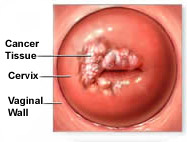 Cervical cancer
or cancer of the cervix is an abnormal growth of malignant (cancer) cells
in the cervix. It is the second most common cancer in females and it is successfully
curable in the early stages. Cervical cancer occurs most commonly between
40 and 55 years of age.
Cervical cancer
or cancer of the cervix is an abnormal growth of malignant (cancer) cells
in the cervix. It is the second most common cancer in females and it is successfully
curable in the early stages. Cervical cancer occurs most commonly between
40 and 55 years of age. 

 Sometimes
abnormal cells develop in the breast tissue, forming a lump or tumor. This is
the most common type of cancer in women.
Sometimes
abnormal cells develop in the breast tissue, forming a lump or tumor. This is
the most common type of cancer in women. 


